

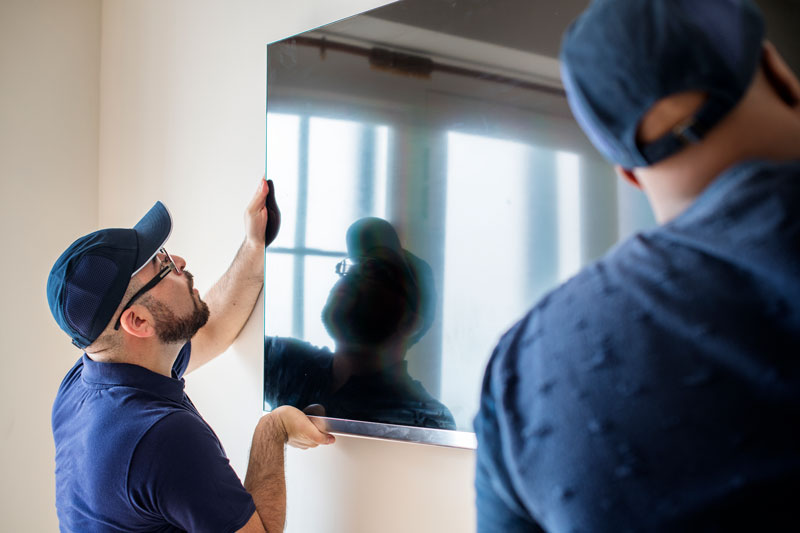
Gone are the days of the massive entertainment center taking up half the living room. Modern televisions are sleek, thin, and designed to look like art on the wall. Mounting your TV creates a clean, minimalist aesthetic that opens up floor space and gives your home a high-end feel. However, getting that TV from the box to the wall is often more stressful than it looks.
We have all seen the “Pinterest fails” of TVs crashing down in the middle of the night or hanging crookedly at a neck-straining height. In the Coachella Valley, where homes are constructed with a mix of wood studs, metal studs (in newer condos), and drywall over masonry, knowing exactly what is behind your paint is crucial. A professional mount isn’t just about putting screws in the wall; it’s about ensuring those screws are anchored into something that can actually hold the weight of a 75-inch screen for the next decade.
Identifying the Studs (and What’s Between Them)
The number one rule of TV mounting is: hit the stud. Drywall anchors—even the ones that claim to hold 100 pounds—are risky for expensive electronics that move on articulating arms. As you pull the TV away from the wall to swivel it, the leverage force multiplies, ripping standard anchors right out of the gypsum board.
Finding the stud can be tricky. Electronic stud finders can give false positives, beeping at water pipes or electrical conduits running vertically inside the wall. Drilling into a water pipe is a disaster; drilling into a 110-volt electrical wire is dangerous. A skilled handyman uses a combination of magnetic tools, electronic sensors, and construction knowledge to locate the framing center with precision. In many desert condos, we encounter metal studs, which require different toggle bolts and drill bits than wood studs. Using a wood lag bolt on a metal stud will simply strip the hole and fail. Home improvement resources like The Family Handyman emphasize that knowing your wall type is the first step in avoiding a smashed screen.
The Art of Hiding the Wires
A floating TV looks incredible—until you see the “black spaghetti” of HDMI cables and power cords dangling down the wall to the outlet. It ruins the illusion.
Professional mounting includes cable management. For a truly clean look, we can often route low-voltage cables (like HDMI and optical audio) inside the wall, entering behind the TV and exiting down near the baseboard. For the power cord (which generally cannot be run inside the wall due to fire codes unless you use a specialized in-wall power kit), we can install sleek, paintable raceways that blend seamlessly with your wall color. This attention to detail transforms a “DIY job” into a showroom-quality installation. Organizations like CEDIA (Custom Electronics Design and Installation Association) often highlight that cable management is what separates professional integrators from amateurs.
Viewing Angles and Ergonomics
Finally, there is the issue of placement. One of the most common mistakes DIYers make is mounting the TV too high—often above a fireplace. While this looks popular in magazines, it forces you to crane your neck upward, leading to discomfort during a two-hour movie.
This is known as the “front row at the movie theater” effect. A professional can help you calculate the optimal viewing height based on the distance to your sofa and the size of the screen. If the only spot available is high up (like over a mantle), we can recommend and install “mantle mounts” that allow the TV to pull down to eye level when in use and retract back up when you are done. This ensures your home theater setup is as comfortable as it is stylish.
Your Coachella Valley Experts for TV Mounting Services
Don’t trust your expensive new 4K TV to a plastic drywall anchor and a guess. We ensure your screen is level, secure, and perfectly positioned for movie night, with wires tucked neatly away. Trust B Frye The Handy Guy to elevate your entertainment experience. Explore our TV Mounting Services or book an installation today via our Contact Us page.