

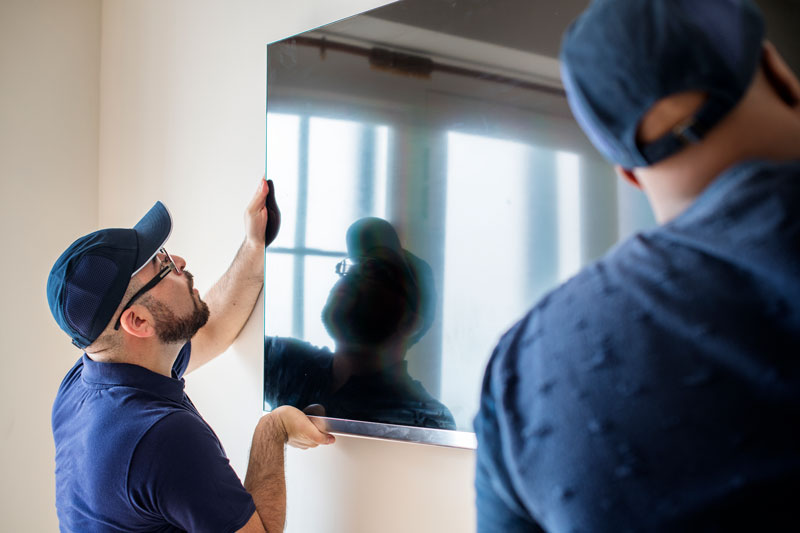
A wall-mounted television frees up floor space, cuts glare, and gives any desert living room a clean, modern look that suits Coachella Valley homes from mid-century Palm Springs to newer builds in La Quinta. Done well, it disappears into the wall. Done poorly, it cracks drywall, sags over time, or worse, pulls free and falls.
The difference comes down to understanding how the wall is built and what hardware actually carries the load. Our crew mounts screens every week across the valley, and you can see how neighbors rate that work on our verified local profile. The steps below explain what a careful installation involves.
Why Proper Mounting Matters More Than the Bracket
Most failed installs are not caused by a cheap bracket; they are caused by hardware sunk into nothing but drywall. Half-inch gypsum board has very little pull-out strength, so a screen anchored only to the surface is borrowing time. A flat-panel television plus a full-motion arm can place well over a hundred pounds of leverage on a few fasteners. Spreading that load into the home’s framing is the entire job, and it is why our professional TV mounting service starts with the structure, not the screen.
Finding the Studs Behind the Wall
Wood studs are typically spaced sixteen inches on center, though older Palm Springs homes and remodels can vary. A quality stud finder locates the framing, and we confirm with a small probe before committing. Mounting into at least two studs gives the bracket a foundation that will hold for decades. When stud spacing does not line up with the ideal screen position, we install a backing board or use a mount with a wider rail so the load still lands on framing rather than hollow drywall.
When You Must Use Anchors
Sometimes a stud simply is not where you need it, such as on a partial accent wall or over a recessed niche. In those cases heavy-duty toggle anchors rated for the combined weight become essential. The Consumer Product Safety Commission documents how unstable televisions cause serious injuries, and its tip-over prevention guidance is worth reading before any wall job. We match anchor ratings to the screen weight with a healthy safety margin rather than to the minimum the package allows.
Hiding Cables the Right Way
Dangling cords undo an otherwise clean install. Where code allows, an in-wall rated cable kit routes power and HDMI behind the drywall for a wireless look. Using only components listed for in-wall use matters for fire safety, a point the Electrical Safety Foundation International stresses in its home electrical safety resources. Where in-wall routing is not appropriate, a paintable raceway keeps everything tidy without violating code.
Mounting Above a Fireplace
Fireplace mounts are popular in Rancho Mirage and Palm Desert great rooms, but heat and height both need planning. Excess heat shortens electronics’ lifespan, so we check mantel clearance and recommend a pull-down or tilting mount to bring the screen to a comfortable viewing angle. If the heat profile is wrong for a television, we say so rather than install something that will fail early.
Choosing the Right Mount Type
Fixed mounts sit closest to the wall and suit a screen viewed straight on. Tilting mounts help when the television sits high. Full-motion arms let you pull the screen out and angle it toward a kitchen or patio, which fits open desert floor plans well. The heavier the screen and the more articulation you want, the more the anchoring underneath has to do, which is why mount selection and wall prep are decided together.
Getting Height and Glare Right
A screen mounted too high causes neck strain over time. As a rule, the center of the picture should sit near eye level from your usual seat, which is lower than most people expect. Coachella Valley living rooms also fight bright afternoon light, so we factor window placement into the position to reduce glare and reflections before a single hole is drilled.
Common DIY Mistakes We Repair
The calls we get most often involve a screen anchored only into drywall, a bracket leveled to the floor instead of true level, or cables run loosely across a wall. Another frequent issue is a television that was never secured against tipping in a home with children. Correcting these after the fact usually means patching drywall and remounting, so it pays to do it once, correctly.
When to Call a Coachella Valley Pro
If your wall is plaster, brick, or has unknown framing, or if the screen is large, heavy, or going above a fireplace, a professional install protects both the television and the wall. Vacation-rental owners across Palm Springs especially value a mount that guests cannot knock loose. We bring the right anchors, the right mount, and the experience to read each wall correctly the first time.
Keeping a Coachella Valley home in shape often means coordinating more than one trade, and we are happy to steer neighbors toward vetted help that falls outside our handyman scope. Households that also need professional rooter and drain service or expert drain cleaning can rely on those specialists to handle the work in their own service areas, so every part of the project stays in experienced hands.
Your Coachella Valley TV Mounting Specialists
From a single bedroom screen to a great-room theater wall, we mount televisions cleanly and safely across the valley. Book a consultation and we will assess your wall, recommend the right mount, and hide the cables for a finished look.